
Legal Data Deserves Local Control
The Quiet Dependency in Modern Legal Workflows
Most legal workflows today run on systems you don’t own.
Documents are drafted locally, then uploaded. Shared through links. Stored on remote servers. Processed by tools that live somewhere else.
It works. It’s fast. It’s become standard. But it creates a quiet dependency:
Your ability to protect legal information depends on infrastructure you don’t control.
Control Changed Before Most People Noticed
This wasn’t always the case. Legal work used to be bounded by physical constraints: files in offices, access limited by proximity, control defined by custody.
Digital systems removed those constraints. That brought speed and flexibility. It also introduced something harder to see: loss of control without loss of access.
You can still reach your data. You just don’t fully govern what happens to it.
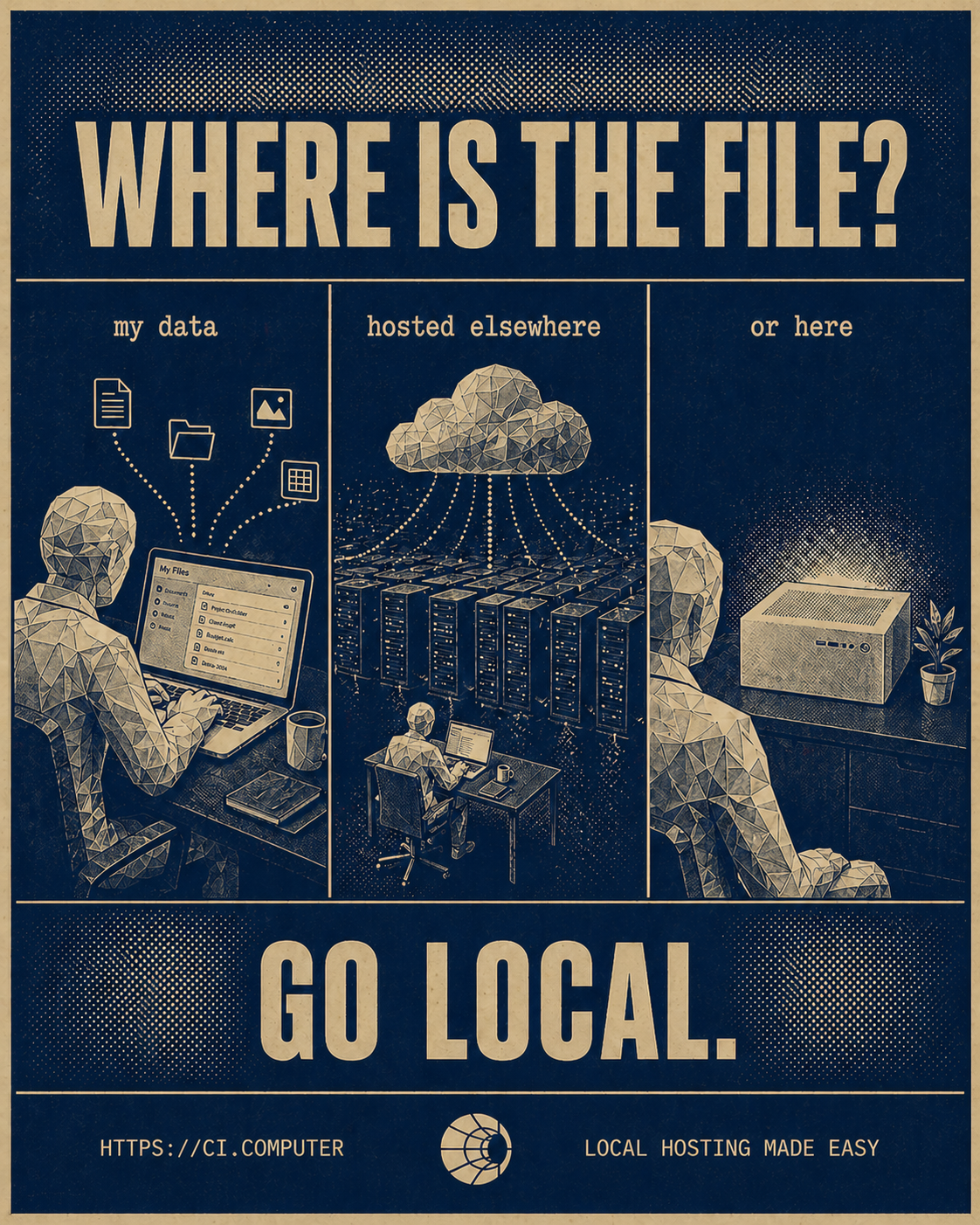
Why Cloud Architecture Creates Legal Tension
Cloud-based tools are designed around availability and collaboration.
That means:
- data is replicated across systems
- access is managed through permissions
- storage is abstracted away from the user
In most industries, this is an advantage. In legal work, it introduces tension.
Confidentiality isn’t just about preventing unauthorized access. It’s about maintaining clear boundaries: knowing where information resides, who can interact with it, and how it moves. When those boundaries become opaque, risk increases.
AI Increases the Visibility Problem
The shift becomes more pronounced with AI.
AI systems don’t just store information. They process it.
When you use a cloud-based AI tool, you’re not simply uploading a document. You’re providing context: facts, relationships, strategies that the system interprets to produce an output.
That interaction may involve:
- temporary storage
- logging
- internal processing pipelines
Depending on the system, those details may not be fully visible to the user. From a technical perspective, this is normal. From a legal perspective, it raises questions that are harder to answer after the fact than before:
- Where did the data go?
- Who had access to it?
- Does it remain protected?
Professional Duties Have Not Changed
Legal standards haven’t relaxed to accommodate these uncertainties.
The duty to safeguard client information remains. The expectation of competence now includes understanding digital systems. The responsibility for outcomes still rests with the lawyer.
What’s changed is the environment those duties operate in.
The Local-First Model
A different model is starting to emerge.
Instead of sending data outward to cloud platforms, external processors, and shared infrastructure, some systems are being designed to keep data local.
A local-first approach means:
- information stays on a device or controlled server
- processing happens within that environment
- external access is explicit, not assumed
It doesn’t eliminate complexity. But it changes the direction of risk.
Governability Over Assumptions
In a local system:
- you know where the data is stored
- you control when it leaves
- you define who can access it
There’s no dependency on a vendor’s default settings or evolving policies.
That doesn’t make the system automatically secure. It makes it governable.
Companion Intelligence Positioning
This is the direction systems like Companion Intelligence are built around.
Instead of relying on cloud infrastructure, the model centers on:
- Local inference: AI runs on hardware you control
- Private memory: your data isn’t used to train external systems
- Controlled access layers: you decide what is shared, and when
- Modular tools: applications operate within your environment, not outside it
The goal isn’t to remove capability. It’s to align capability with ownership.
Practical Workflow Impact
For legal professionals, this changes how workflows can be structured.
Drafting, research, and analysis can happen without sending sensitive information into external systems.
For clients, it creates a way to prepare and organize information without exposing it prematurely.
In both cases, it reduces reliance on assumptions about how third-party systems behave.
Core Principle: Responsibility Requires Control
The broader shift is not just about technology.
It’s about reestablishing a basic principle:
Control over information should match responsibility for it.
Right now, those two things are often separated.
Lawyers are responsible for protecting client data. But the systems they use are designed and operated by others.
That gap is where many of the risks begin.
Final Takeaway
The question going forward isn’t whether legal work will continue to use digital tools or AI.
It will.
The question is where those tools operate and who governs them.
Because in a system where responsibility cannot be delegated,
control becomes the most important feature.
